
Why Most Property Managers Track the Wrong Things
Walk into most commercial property management offices and ask what they track. You will hear occupancy rate and rent collections. That is it: two numbers, reported monthly, reviewed when something goes wrong. It is the equivalent of running a business by checking your bank balance and nothing else.
Occupancy and collections matter, but they are lagging indicators. By the time your occupancy rate drops, the damage was done months ago when a dissatisfied tenant decided not to renew. By the time collections fall, the relationship had already deteriorated to the point where the tenant stopped prioritizing your invoice. Lagging indicators tell you what already happened. Leading indicators tell you what is about to happen.
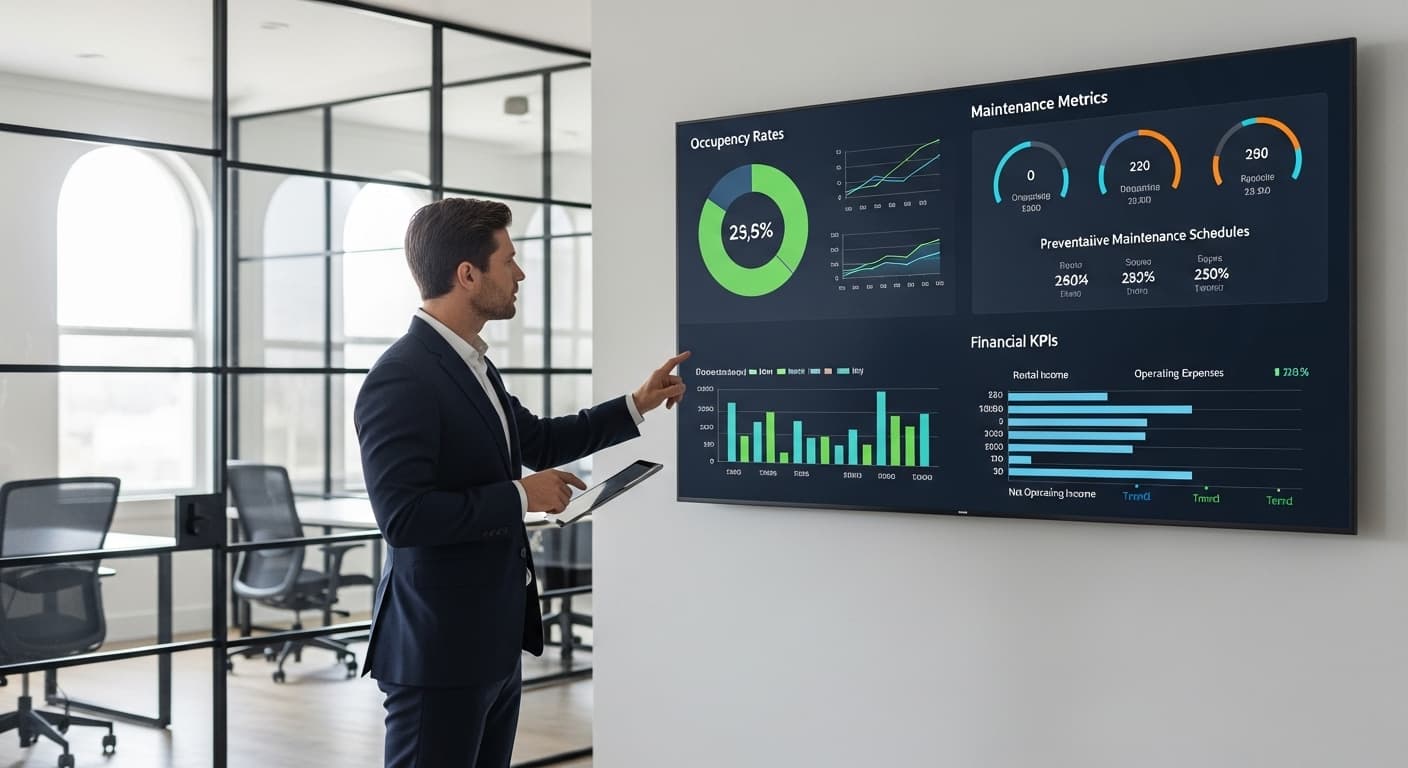
The property managers who consistently outperform their market track 8 to 10 KPIs that include both leading and lagging indicators. They see problems forming before they become vacancies. They spot maintenance trends before they become capital emergencies. They measure tenant satisfaction before it becomes tenant turnover. The data itself does not fix anything, but it creates the visibility that makes proactive management possible, and proactive management is the difference between a 95 percent occupancy rate and an 82 percent one.
The Core Financial KPIs
Net Operating Income (NOI) is the single most important financial metric in commercial property management. It represents your total rental income minus all operating expenses: maintenance, insurance, property taxes, management fees, and utilities paid by the landlord. NOI directly determines your property's market value (value equals NOI divided by cap rate), so every dollar of NOI improvement translates into $10 to $20 of increased asset value depending on your market's cap rate.
Track NOI monthly and compare it to the same month in the prior year to account for seasonal variations. More importantly, decompose NOI into its components. Is NOI growing because rents increased, or because expenses decreased? Is it declining because of higher vacancy, or because maintenance costs spiked? The top-line number is useful, but the decomposition is where actionable insights live.
Beyond NOI, track your operating expense ratio (operating expenses divided by gross income). A healthy commercial property typically runs a 35 to 45 percent operating expense ratio. If yours is above 50 percent, investigate which expense categories are above market benchmarks. Also monitor your cost per unit or cost per square foot for maintenance, which reveals whether your vendor contracts and preventive maintenance programs are performing efficiently. Industry benchmarks for office properties run $2.50 to $4.00 per square foot annually for maintenance; retail properties typically run $1.50 to $3.00.
Occupancy Rate and Vacancy Economics
Occupancy rate is the most watched metric in property management, but most managers calculate it too simply. Physical occupancy, the percentage of units with signed leases, does not tell the full story. Economic occupancy, the percentage of potential gross rent actually collected, is the metric that matters to your bottom line.
The gap between physical and economic occupancy reveals hidden revenue leakage. A property can be 95 percent physically occupied but only 88 percent economically occupied when you account for rent concessions, free rent periods, tenant defaults, and below-market renewal rates. That 7 percentage point gap on a $2 million gross rent property represents $140,000 in annual revenue you are not capturing.
Track both metrics monthly and investigate the gap. Common causes include legacy tenants on below-market leases who renewed without rate adjustments, excessive concessions offered during leasing to fill space quickly, and tenants on payment plans or in arrears who technically occupy space but are not paying full rent. Each cause has a different remedy: below-market leases need a structured rent increase strategy, excessive concessions need better leasing discipline, and collection issues need a defined escalation process. You cannot address any of them if you are only looking at physical occupancy.
Tenant Retention and Satisfaction Metrics
Tenant retention rate is a leading indicator disguised as a lagging one. Yes, you calculate it after the fact (number of tenants who renewed divided by number eligible to renew), but the factors that drive it (responsiveness, maintenance quality, communication, and overall experience) are measurable in real time.
The cost of tenant turnover in commercial property is staggering. When a tenant vacates, you lose rent during the vacancy period (average 4 to 8 months for office space), spend $15 to $50 per square foot on tenant improvements for the new occupant, pay leasing commissions of 4 to 6 percent of the total lease value, and absorb marketing and showing costs. For a 3,000 square foot office unit at $25 per square foot, a single turnover event costs $75,000 to $150,000 in direct and indirect costs. Retaining that tenant, even at a modest rent discount, is almost always the better financial outcome.
Measure tenant satisfaction proactively with quarterly pulse surveys (3 to 5 questions, takes under 2 minutes to complete). Track your Net Promoter Score among tenants. Monitor informal signals like maintenance request frequency, complaint patterns, and engagement with building communications. When a tenant's satisfaction signals decline, you have a 6 to 12 month window to intervene before they start shopping for alternatives. That window is the entire point of tracking satisfaction: it gives you time to act while it still matters.
Maintenance and Operations KPIs
Maintenance response time is the KPI that tenants feel most directly, and it has a disproportionate impact on satisfaction and retention. Track three tiers: emergency response time (target under 2 hours for situations affecting safety or business operations), urgent response time (target under 24 hours for issues that impair tenant operations), and routine response time (target under 3 business days for non-critical requests).
Beyond response time, measure resolution time: how long from the initial request to the problem being fully resolved. A 2-hour response that leads to a 3-week resolution is worse than a 4-hour response with same-day resolution. Tenants care about the fix, not the acknowledgment. Track your first-visit resolution rate (the percentage of maintenance issues resolved on the first technician visit). Industry leaders achieve 75 to 85 percent first-visit resolution; the industry average hovers around 55 percent. Low first-visit resolution rates indicate poor diagnosis during the request intake, undertrained maintenance staff, or technicians who lack the parts and materials needed for common repairs.
The collections rate, the percentage of billed rent actually collected within the billing period, rounds out the essential operations metrics. Target 98 percent or above for a healthy portfolio. Track collections aging: current (paid on time), 30 days past due, 60 days, and 90-plus days. Any individual tenant moving from current to 30 days is a trigger for immediate outreach. Any tenant at 60 days should be in a formal payment plan discussion. The pattern of your collections aging tells you whether your accounts receivable process is working or whether problems are compounding silently.
How Tracking KPIs Transformed Beacon Property Group
Beacon Property Group is a case study in what happens when you move from reactive to data-driven property management. When they came to TwoChi, Beacon owned 8 commercial properties across Central Florida with 142 tenant units. Their vacancy rate was 23 percent, nearly three times the market average of 9 percent. Maintenance response times averaged 11 days. Collections were inconsistent and no one could articulate why tenants were leaving.
The root cause was not bad properties or a weak market. It was an absence of systematic measurement and the management discipline that measurement enables. Beacon had no standardized KPI tracking, no tenant communication platform, no maintenance SLA with their vendors, and no accountability structure for property-level performance. They were managing reactively: fixing things when tenants complained loudly enough and filling vacancies when the revenue loss became painful.
TwoChi deployed a comprehensive property management system with KPI dashboards, automated tenant communications, vendor accountability tracking with SLA enforcement, and financial collections automation. Within 12 months, Beacon's vacancy rate dropped from 23 percent to 4 percent, maintenance response time went from 11 days to 48 hours, collections rate improved to 98.5 percent, and annual NOI increased by $340,000. The transformation was not magic. It was measurement combined with process. As Marcus Webb, Beacon's Managing Partner, put it: the vacancy drop alone paid for everything within three months. The KPIs did not fix the problems directly, but they made the problems visible, measurable, and impossible to ignore.
Frequently Asked Questions
Ready to Take the Next Step?
Let's discuss how TwoChi can help your business grow.
Improve Your Property PerformanceMore from Physical Infrastructure
Office Technology Setup for Growing Teams: A Complete Guide
Most growing teams assemble their office technology reactively: a router here, a shared printer there, a Zoom account when the first client complains about audio quality. That patchwork approach costs more, breaks more often, and creates security vulnerabilities that compound as you scale. Here is how to build it right from the start.
ReadHow to Reduce Commercial Property Vacancy Rates
Every month a commercial space sits vacant costs you money: not just lost rent, but maintenance, insurance, and depreciation. Here are the strategies that consistently reduce vacancy rates and keep properties fully leased.
Read